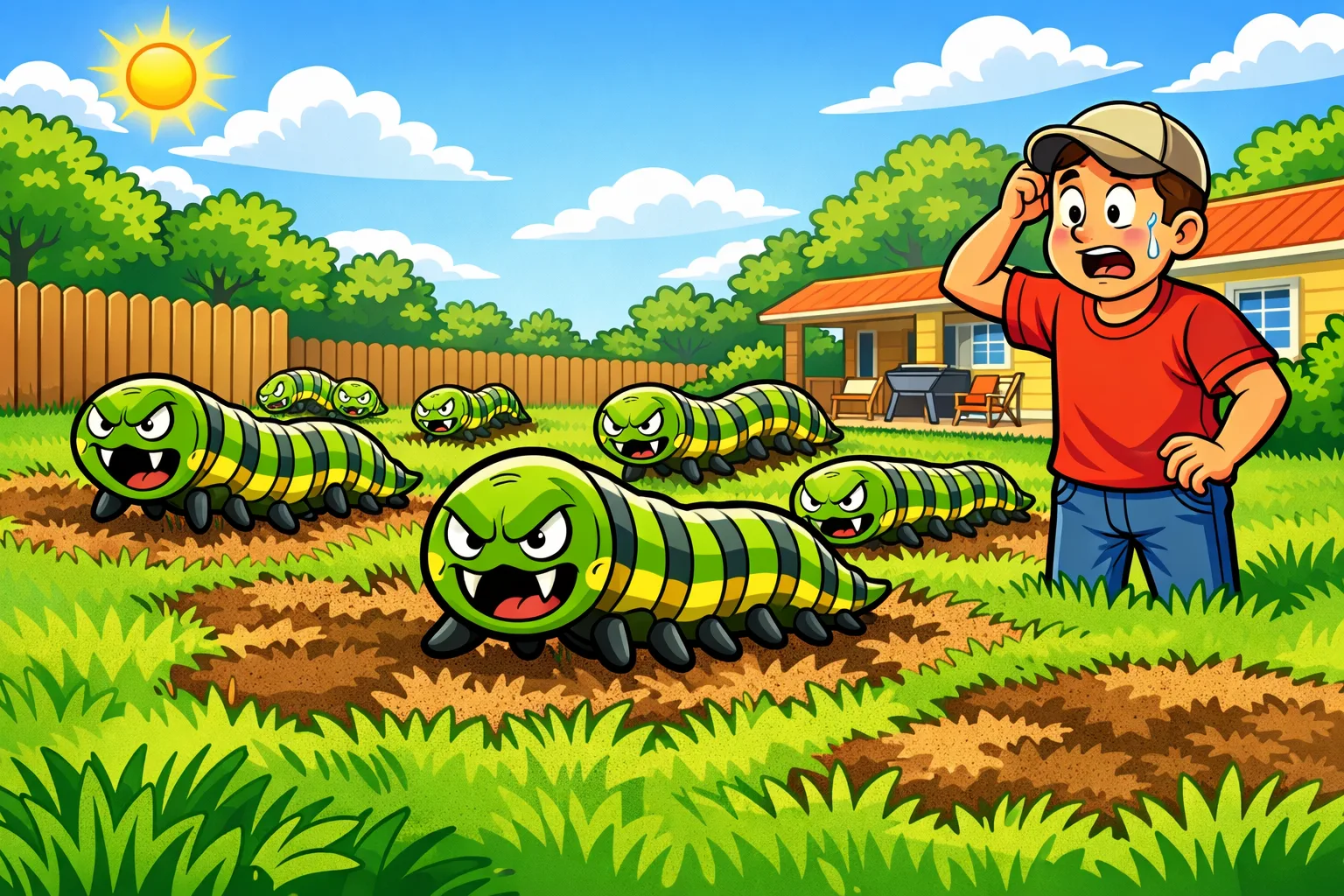
Every fall, we get the same frantic phone calls from homeowners across Valdosta and South Georgia: "My lawn looked fine yesterday and now there are huge brown patches everywhere." Nine times out of ten, the culprit is army worms. These caterpillars are the single most destructive lawn pest in our region, and they can reduce a thick, healthy Bermuda or St. Augustine lawn to bare dirt in less than 72 hours. After more than a decade of treating army worm infestations across Lowndes County, I can tell you that understanding these pests and acting fast are the two things that separate a lawn that recovers from one that needs complete re-sodding.
What Are Army Worms?
Army worms are the larval stage of the fall armyworm moth (Spodoptera frugiperda), a small gray-brown moth that migrates into South Georgia from tropical and subtropical regions each year. The adult moths themselves are harmless to your lawn. The damage comes entirely from their caterpillar offspring, which hatch from egg masses laid on grass blades and begin feeding immediately.
The name "army worm" comes from the way these caterpillars move. Once they strip one area of turf down to nothing, they march together in large groups to the next patch of grass, advancing across a lawn like an army on the move. A single female moth can lay up to 1,000 eggs, and each egg mass can contain 100 to 200 eggs. When conditions are right, populations explode rapidly, and that is exactly what happens in the warm, humid climate of South Georgia.
Army worms in your lawn are not the same as true armyworms (Mythimna unipuncta), which primarily feed on field crops. The fall armyworm is the species responsible for nearly all residential lawn damage in the Valdosta area. They prefer warm-season turfgrasses, which means Bermuda grass and St. Augustine grass, the two dominant lawn types in our region, are their primary targets.
Signs of Army Worms in Your Lawn
Catching an army worm infestation early is critical. The difference between treating on day one and treating on day three can be the difference between a lawn that bounces back in a few weeks and one that needs thousands of dollars in sod replacement. Here are the signs of army worms in your lawn that every South Georgia homeowner should know:
- Rapidly expanding brown patches. Army worm damage appears suddenly. You will notice irregular brown or bare areas that seem to grow larger by the hour. Unlike drought stress, which develops gradually over days or weeks, army worm damage can spread across several hundred square feet overnight.
- Grass blades chewed to the stem. Look closely at the edges of damaged areas. Healthy grass transitions abruptly to chewed, ragged stubble. Army worms eat the green blade tissue and leave behind the brown stems, creating a scalped appearance that looks like someone set the mower far too low.
- Increased bird activity. If you notice an unusual number of birds, particularly mockingbirds, blue jays, and starlings, feeding on your lawn, they are likely eating army worm caterpillars. Heavy bird activity on your turf is one of the earliest signs of army worms in your lawn.
- Green frass (droppings) on the soil surface. Army worm droppings look like tiny green or brown pellets scattered across the soil. If you part the grass blades near a damaged area and see these small pellets, army worms are present.
- Visible caterpillars in early morning or evening. Army worms feed most actively during the cooler parts of the day. Go out at dawn or dusk and inspect the transition zone between healthy grass and damaged areas. You may see the caterpillars actively feeding on the blades.
The soap flush test is the fastest way to confirm an army worm infestation. Mix two tablespoons of liquid dish soap into a gallon of water and pour it over a two-by-two-foot area of grass near the edge of the damage. Army worms will crawl to the surface within two to three minutes to escape the irritant. If you count three or more caterpillars per square foot, you have an infestation that requires immediate treatment.
Why Army Worms Are Worse in South Georgia
South Georgia sits in the geographic sweet spot for fall armyworm infestations. Several factors make our region particularly vulnerable compared to areas further north in the state:
- Earlier arrival, longer season. Because fall armyworm moths migrate from the south, Valdosta and surrounding areas are among the first places in Georgia to see infestations each year. While metro Atlanta might not see army worms until mid-September, we can have active populations as early as late July. Our warm fall temperatures also extend the feeding season well into November some years, giving army worms more time to reproduce and cause damage.
- Multiple generations per year. In South Georgia's long growing season, fall armyworms can produce three to four generations between midsummer and first frost. Each successive generation tends to be larger than the last, which is why the worst damage typically occurs in September and October when third- and fourth-generation populations peak.
- Warm-season turf dominance. Bermuda grass and St. Augustine grass are the foundation of nearly every residential lawn in the Valdosta area, and both are highly preferred food sources for army worms. Bermuda grass in particular seems to attract heavier infestations, possibly because moths prefer to lay eggs on its fine-textured blades.
- Humidity and rainfall patterns. South Georgia's summer and early fall rainfall creates lush, fast-growing turf that provides abundant food for developing caterpillar populations. The high humidity also supports the survival of army worm eggs and young larvae.
The UGA Cooperative Extension tracks armyworm activity across the state and publishes alerts when moth trap counts indicate an impending outbreak. Keeping an eye on these reports during late summer and fall can give you a valuable head start on protecting your lawn.
How to Get Rid of Army Worms
Once you have confirmed army worms in your lawn, speed is everything. Every hour of delay means more turf lost. Here is a step-by-step approach to eliminating an active army worm infestation:
- Choose the right insecticide. For homeowner-applied products, look for liquid or granular insecticides containing bifenthrin, permethrin, or cyfluthrin. These synthetic pyrethroids provide fast knockdown of active caterpillars. For a longer-lasting option, products containing chlorantraniliprole offer both contact and residual control. Professional-grade products like Acelepryn provide extended protection but are typically only available through licensed applicators.
- Apply in the late afternoon. Army worms feed most actively in the early morning and evening. Applying insecticide in the late afternoon ensures the product is fresh and active on the grass blades when the caterpillars come out to feed. Avoid applying in the heat of midday when the product can degrade faster and the caterpillars are sheltered deep in the turf canopy.
- Water lightly before application. A light irrigation about 30 minutes before you apply insecticide brings army worms closer to the surface where they will contact the product. Do not water heavily after application, as this can wash the insecticide off the grass blades and into the soil where it will not reach the caterpillars.
- Treat the entire lawn, not just damaged areas. Army worms are mobile. If you only treat the brown patches, the caterpillars currently feeding in the still-green areas will survive and continue spreading. Treat the entire lawn to ensure complete coverage.
- Inspect and retreat if needed. Check the treated area 48 to 72 hours after application. If you still see live caterpillars, a second application may be necessary, particularly if the initial infestation was severe or if rain occurred shortly after treatment.
For homeowners who prefer organic or reduced-chemical approaches, Bacillus thuringiensis var. kurstaki (Bt) is a biological insecticide that specifically targets caterpillars. It is most effective against young, small army worms and must be ingested to work, so thorough coverage of the grass blades is essential. Spinosad is another organic option that provides good control of army worms when applied correctly.
How to Prevent Army Worms
Preventing army worm damage is far less expensive and stressful than dealing with an active infestation. While you cannot completely eliminate the risk in South Georgia, these strategies will significantly reduce your lawn's vulnerability:
- Maintain proper mowing height. Bermuda grass should be mowed at 1 to 1.5 inches and St. Augustine grass at 3.5 to 4 inches. Grass maintained at the correct height is healthier and more resilient, and it recovers faster if army worms do cause damage.
- Avoid over-fertilizing with nitrogen. Excessive nitrogen produces lush, tender growth that is especially attractive to army worm moths looking for egg-laying sites. Follow soil test recommendations and apply nitrogen at moderate rates. The UGA Extension recommends no more than one pound of actual nitrogen per 1,000 square feet per application for Bermuda grass.
- Apply preventive insecticides in mid-summer. Products containing chlorantraniliprole can be applied in June or July to provide season-long protection against army worms. This preventive approach is particularly worthwhile for properties that have experienced infestations in previous years.
- Monitor your lawn weekly during peak season. From late July through October, walk your lawn at least once a week looking for the early signs described above. Check the edges of the lawn, around landscape beds, and near outdoor lighting, which attracts the adult moths.
- Reduce outdoor lighting near the lawn. Fall armyworm moths are attracted to lights at night. If possible, reduce or redirect exterior lighting that shines directly over your lawn during peak moth season. This will not eliminate the risk, but it can reduce the number of moths laying eggs in your turf.
- Encourage natural predators. Ground beetles, parasitic wasps, and birds all feed on army worms. Avoid using broad-spectrum insecticides outside of active infestations, as these products kill beneficial insects along with the pests.
When to Call a Professional
Many homeowners can successfully treat a small or moderate army worm infestation with store-bought products and good timing. However, there are situations where professional treatment is the better choice:
- The infestation covers a large area. Treating a half-acre or larger lawn with consumer-grade equipment is time-consuming and often results in uneven coverage. Professional applicators use truck-mounted sprayers that deliver consistent, thorough coverage at the right application rates.
- The infestation keeps returning. If you have treated army worms multiple times in the same season and they keep coming back, there may be underlying issues such as over-fertilization, excessive thatch, or environmental conditions that are attracting moths to your lawn. A professional can assess these factors and develop a comprehensive management plan.
- You are unsure what is damaging your lawn. Army worm damage can resemble drought stress, fungal disease, chinch bug damage, or grub worm activity. Misidentifying the problem means wasting time and money on the wrong treatment while the real damage continues. A trained technician can quickly distinguish between these issues and recommend the correct course of action.
- You want preventive protection. Professional lawn care companies have access to commercial-grade preventive products that provide longer-lasting protection than most over-the-counter options. A single preventive application in early summer can protect your lawn through the entire army worm season.
At Elite Landscapes, we treat army worm infestations across Valdosta and South Georgia every fall. Our team can typically have a crew on your property within 24 hours of your call, which is critical when army worms are actively destroying turf. We also offer preventive treatment programs that stop army worms before they ever get a foothold in your lawn.
Frequently Asked Questions
What do army worms look like?
Army worm caterpillars are one to one-and-a-half inches long with smooth bodies that range from light green to dark brown or nearly black. The most reliable identifying feature is a distinctive inverted Y-shaped marking on the front of the head. Their body color can vary depending on their diet and the generation, but the Y marking is always present. The adult moths are small and gray-brown with a wingspan of about one-and-a-half inches, but the moths themselves do not damage your lawn.
What time of year do army worms attack?
In South Georgia, army worms can appear as early as late July, but the heaviest infestations typically occur from late August through October. September is the peak month for army worm damage in the Valdosta area. Warm, wet summers tend to produce larger army worm populations, and mild fall temperatures can extend the threat into early November. Unlike some pests that appear on a predictable schedule, army worm timing depends heavily on moth migration patterns and local weather conditions.
Will grass grow back after army worms?
In most cases, yes. Army worms feed on grass blades and stems but typically do not kill the root system or the stolons and rhizomes that allow warm-season grasses to spread. Bermuda grass is especially resilient and will usually recover within two to four weeks after the caterpillars are eliminated, provided the lawn receives adequate water and a light fertilizer application to support regrowth. St. Augustine grass recovers more slowly, often taking four to six weeks. However, if an infestation is severe and goes untreated for an extended period, the stress on the root system can lead to permanent turf loss, particularly in areas with thin or weakened grass.
How fast can army worms destroy a lawn?
Army worms can destroy a lawn with alarming speed. A heavy infestation can strip a typical residential lawn in Valdosta, roughly 5,000 to 10,000 square feet, down to bare soil in two to three days. The speed depends on the density of the caterpillar population and the maturity of the larvae. Larger, late-instar caterpillars consume far more grass than newly hatched ones. This is why early detection matters so much. Catching an infestation when the caterpillars are still small gives you more time to act and reduces the total amount of damage.
If you are dealing with army worms in your lawn or want to protect your property before the next outbreak, contact Elite Landscapes for a free lawn assessment. We serve Valdosta, Lowndes County, and communities throughout South Georgia and North Florida. Call us at (229) 412-1797 to get started.