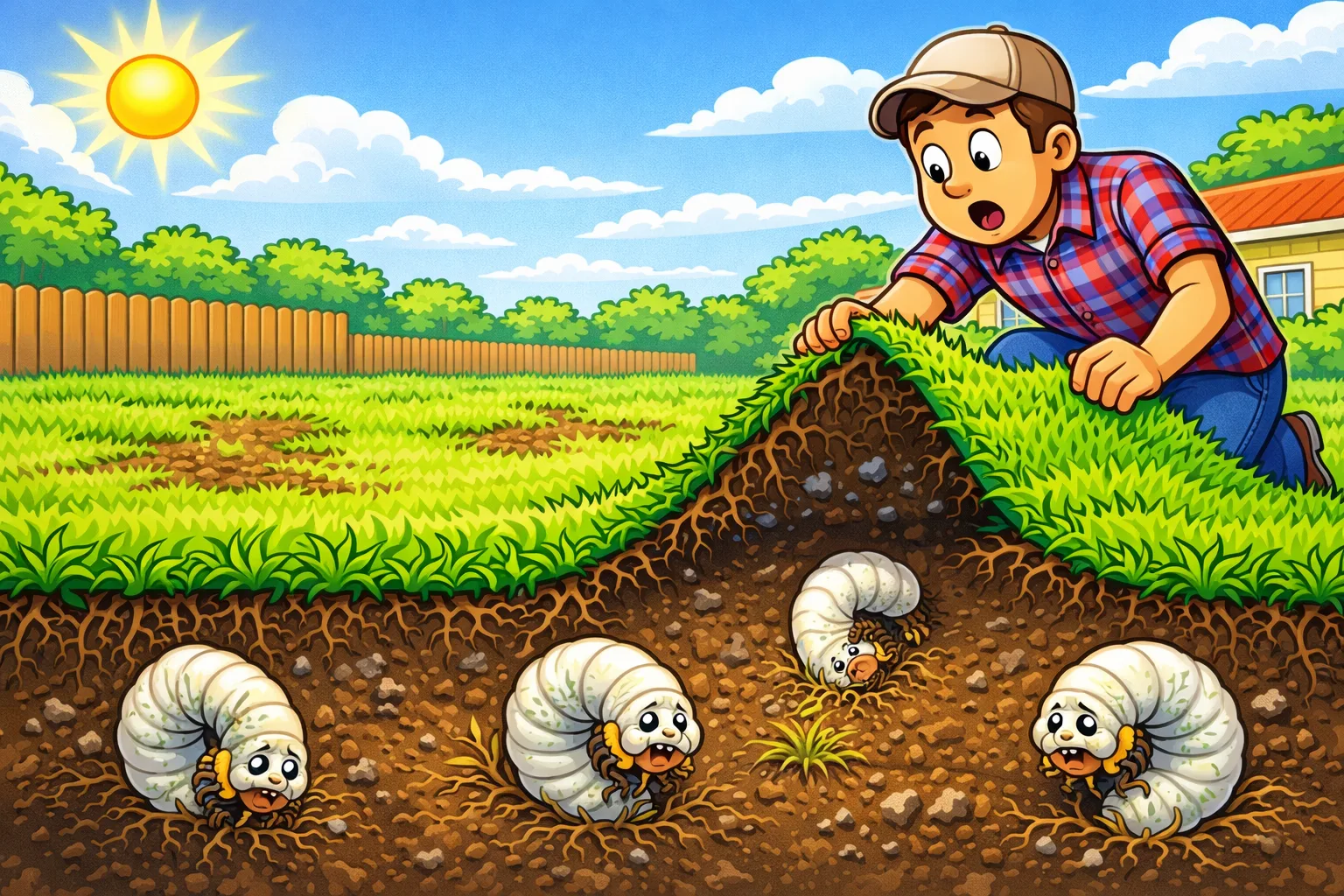
If you have ever walked across your lawn in Valdosta and noticed a section of grass that feels loose underfoot or peels up like a piece of carpet, there is a good chance grubs are responsible. These underground pests quietly feed on the roots of Bermuda and St. Augustine grass throughout South Georgia, and by the time the damage becomes visible above ground, the infestation is already well established. Effective lawn grub treatment starts with understanding what these pests are, recognizing the signs early, and knowing exactly when and how to act.
What Are Lawn Grubs?
Lawn grubs are the larval stage of several species of beetles. In South Georgia, the most common culprits are June bugs (also called May beetles), Japanese beetles, and masked chafers. The adult beetles lay their eggs in lawns during the summer months, and those eggs hatch into small, white, C-shaped larvae that live in the top two to four inches of soil.
The grubs themselves are soft-bodied, typically cream-colored with a brown head capsule, and range from a quarter inch to over an inch long depending on their age. They have six small legs near the head and a slightly darker rear end where digested soil is visible through the skin. Despite their small size, grubs can cause enormous damage because they feed directly on grass roots. Without roots, your turf cannot absorb water or nutrients, and it dies from the ground up.
South Georgia's sandy, well-drained soils and warm climate make our region particularly hospitable to grubs. The loose soil structure makes it easy for adult beetles to burrow and lay eggs, and the mild winters allow some grub species to remain active longer than they would farther north.
Signs of Grub Damage in Your Lawn
Grub damage is tricky to identify because it often looks like something else entirely. The early signs mimic drought stress: irregular patches of grass that turn yellow or brown even when you are watering consistently. In Bermuda grass, the affected areas may thin out gradually. In St. Augustine lawns, you may notice sections that look wilted or off-color compared to the surrounding turf.
The most reliable indicator is the turf pull test. Walk to the edge of a discolored patch and grab a handful of grass. Pull firmly. If the sod lifts away from the soil with little resistance, almost like rolling up a rug, the roots have been severed by grubs feeding below the surface. Healthy grass will hold firmly to the ground because its root system is intact.
Another telltale sign is animal activity. Birds, armadillos, raccoons, and even skunks will dig into your lawn to feed on grubs. If you wake up to find sections of turf torn apart and flipped over, animals have already diagnosed your grub problem for you. In the Valdosta area, armadillo damage is especially common in lawns with active grub infestations.
You may also notice that the affected areas are concentrated in sunny, well-watered sections of the lawn. Adult beetles prefer to lay eggs in moist, warm soil, so irrigated lawns in full sun are often hit harder than shaded or dry areas.
The Grub Life Cycle in South Georgia
Understanding the grub life cycle is essential for timing your lawn grub treatment correctly. In South Georgia, the cycle follows a predictable pattern driven by our warm climate.
Adult beetles, including June bugs, Japanese beetles, and masked chafers, emerge from the soil in late spring and early summer, typically May through July in the Valdosta area. You have probably seen June bugs buzzing around porch lights on warm evenings. After mating, females return to the lawn and lay clusters of eggs two to four inches below the soil surface. Each female can lay 20 to 60 eggs.
The eggs hatch within two to three weeks, and the tiny first-stage grubs begin feeding on grass roots immediately. Through the summer and into early fall, the grubs grow through three stages, called instars, getting progressively larger and consuming more root material at each stage. The heaviest feeding and worst damage occurs from August through October, when the grubs are in their third and final instar.
As soil temperatures drop in late fall, the grubs burrow deeper into the ground, sometimes eight to twelve inches down, to overwinter. In South Georgia, our mild winters mean the grubs do not go as deep or stay dormant as long as they do in northern states. When the soil warms again in spring, the grubs move back toward the surface, feed briefly on roots, and then pupate. The adult beetles emerge a few weeks later to start the cycle over.
This life cycle is why timing matters so much for grub lawn treatment. The window when grubs are small, near the surface, and most vulnerable to treatment is relatively narrow.
How to Check for Grubs
Before spending money on any grub lawn treatment, confirm that grubs are actually the problem. The inspection process is straightforward.
Choose several areas of your lawn, including spots that look damaged and spots that still look healthy. Using a flat shovel or a knife, cut a one-foot-square section of sod about three to four inches deep. Peel the sod back like opening a book and examine the soil and root zone underneath.
Count the grubs you find in that one-square-foot section. A few grubs are normal and do not require treatment. Healthy lawns can tolerate a low level of grub activity without showing damage. The threshold for treatment is generally around 10 grubs per square foot for Bermuda grass and slightly lower, around 6 to 8, for St. Augustine, which has a shallower root system and less tolerance for root loss.
Check multiple areas of the lawn to get an accurate picture. Grub populations are rarely uniform across an entire property. You may find heavy concentrations in one section and almost none in another. After inspecting, press the sod flaps back into place and water them in. They will recover quickly as long as the roots are still partially intact.
The best time to check for grubs in South Georgia is late August through September, when third-instar grubs are large enough to spot easily and feeding actively near the surface.
Lawn Grub Treatment Options
Once you have confirmed a grub infestation above the treatment threshold, you have several effective options. The right choice depends on whether you are dealing with an active infestation that needs immediate control or planning ahead for prevention.
Chemical Treatments for Active Infestations
When grubs are already present and causing damage, you need a curative product that kills grubs quickly. Trichlorfon, sold under the brand name Dylox, is the most widely recommended curative grub treatment. It works on contact, killing grubs within a few days of application. Trichlorfon is most effective when applied in late summer or early fall while grubs are actively feeding in the top few inches of soil.
To apply trichlorfon effectively, mow your lawn first and then water the treated area with about half an inch of irrigation immediately after application. The water moves the product down through the thatch layer and into the root zone where the grubs are feeding. Without adequate watering, the product will not reach the grubs and the treatment will fail.
Carbaryl is another curative option, though it is slightly less effective than trichlorfon and takes longer to work. Both products are broad-spectrum insecticides, so they will also kill beneficial insects in the treated area.
Biological and Organic Treatments
For homeowners who prefer to avoid synthetic chemicals, there are biological lawn grub treatment options worth considering. Beneficial nematodes, specifically Heterorhabditis bacteriophora, are microscopic worms that actively hunt and parasitize grub larvae in the soil. They are applied as a liquid drench and work best when the soil is moist and soil temperatures are between 60 and 90 degrees Fahrenheit, which covers most of the growing season in South Georgia.
Nematodes are most effective against younger, smaller grubs, so timing the application for late summer when grubs are still in their first or second instar gives the best results. They are living organisms, so they must be applied in the evening or on a cloudy day to avoid UV damage, and the lawn should be irrigated before and after application to keep the soil moist.
Milky spore (Paenibacillus popilliae) is a bacterial disease that specifically targets Japanese beetle grubs. It is applied as a powder and takes one to three years to build up sufficient levels in the soil to provide reliable control. Once established, however, milky spore can persist in the soil for 10 years or more, providing long-term, self-sustaining control without repeated applications. The downside is that milky spore only affects Japanese beetle larvae, not June bug or masked chafer grubs, so it is not a complete solution if multiple species are present.
Preventive Grub Control
Prevention is almost always more effective and less expensive than treating an active grub infestation. The goal of preventive grub control is to kill grubs shortly after they hatch from eggs, before they grow large enough to cause significant root damage.
GrubEx, which contains the active ingredient chlorantraniliprole, is the gold standard for preventive grub control. Chlorantraniliprole has a long residual life in the soil, meaning you can apply it well in advance of egg hatch and it will still be active when the grubs appear. In South Georgia, the ideal application window for chlorantraniliprole is April through early June, before adult beetles begin laying eggs.
Apply GrubEx or a comparable chlorantraniliprole product with a broadcast spreader at the rate specified on the label, then water it in with at least half an inch of irrigation. The product binds to organic matter in the soil and remains active for several months, protecting your lawn through the entire egg-laying and hatching season.
Imidacloprid is another effective preventive option, though it has a shorter residual and should be applied closer to the expected egg hatch, typically in June or early July for the Valdosta area. Like chlorantraniliprole, it must be watered in immediately after application.
If your lawn has had grub problems in consecutive years, a preventive application is strongly recommended. It is far easier to stop grubs before they start feeding than to deal with the damage after the fact.
How to Repair Grub Damage
After treating for grubs, the next step is restoring the damaged areas of your lawn. The recovery approach depends on the severity of the damage and your grass type.
For Bermuda grass lawns with moderate grub damage, the good news is that Bermuda is an aggressive spreader. Once the grubs are eliminated and the root zone is no longer under attack, healthy Bermuda grass will send runners into the damaged areas and fill them in naturally. To speed the process, rake out any dead material, apply a starter fertilizer, and keep the area consistently watered. In South Georgia's warm growing season, Bermuda can fill in moderate bare spots within four to six weeks.
St. Augustine grass does not spread as aggressively as Bermuda, so larger damaged areas may need to be patched with fresh sod. Remove the dead turf, loosen the soil underneath, and lay new St. Augustine sod. Water the new sod thoroughly for the first two weeks to help it establish roots.
For severe damage where large sections of the lawn are dead, re-sodding the affected areas is usually the fastest path to recovery regardless of grass type. Trying to nurse a heavily damaged lawn back to health often takes longer and costs more than simply replacing the destroyed turf.
In all cases, make sure the grub infestation has been fully addressed before investing in repairs. There is no point in laying new sod on top of an active grub population.
When to Call a Professional
Many grub problems can be handled by homeowners with the right products and good timing. However, there are situations where professional lawn grub treatment makes more sense.
If the infestation covers a large area or spans most of your property, professional-grade application equipment will deliver more uniform coverage than a homeowner spreader. If you have treated for grubs but the problem keeps coming back year after year, there may be underlying conditions, such as excessive irrigation, compacted soil, or landscape lighting that attracts egg-laying beetles, that a professional can identify and address.
Misidentification is another common issue. Not every brown patch is caused by grubs. Fungal diseases like large patch, chinch bug damage in St. Augustine, and even improper watering can produce symptoms that look similar to grub damage. A lawn care professional can accurately diagnose the problem and recommend the right treatment, which saves you the time and expense of treating for the wrong pest.
Professional programs also offer the advantage of properly timed preventive applications. Because the treatment window for grub prevention is specific and easy to miss, having a scheduled program ensures the product goes down at the right time every year.
Frequently Asked Questions
How many grubs per square foot is too many?
The general threshold for treatment is around 10 grubs per square foot in Bermuda grass and 6 to 8 in St. Augustine grass. A few grubs in your soil are normal and healthy lawns can tolerate low levels without visible damage. If your counts consistently exceed these thresholds across multiple sample areas, treatment is warranted.
What is the best time to treat for grubs in Georgia?
For preventive treatment, apply chlorantraniliprole (GrubEx) between April and early June in South Georgia, before adult beetles lay eggs. For curative treatment of active infestations, late August through early October is the best window, when grubs are feeding near the surface but have not yet burrowed deep for winter. Treating outside these windows significantly reduces effectiveness.
Will grub-damaged grass grow back?
It depends on the severity and your grass type. Bermuda grass is resilient and will often spread back into moderately damaged areas on its own within four to six weeks once grubs are eliminated. St. Augustine recovers more slowly and may need to be re-sodded in heavily damaged spots. In either case, the grubs must be treated first or the new growth will simply be eaten again.
Do grubs come back every year?
Yes, grubs can return every year because adult beetles lay new eggs each summer. A single season of treatment does not prevent future infestations. If your lawn has had grub problems, an annual preventive application of chlorantraniliprole or imidacloprid in late spring is the most reliable way to break the cycle and keep grubs from coming back.
Elite Landscapes provides professional grub treatment and prevention programs for residential and commercial properties throughout Valdosta and South Georgia. Whether you are dealing with active grub damage right now or want to set up a preventive plan to protect your lawn year-round, our team has the experience and equipment to get it done right. Contact us for a free lawn assessment, or call (229) 412-1797.